
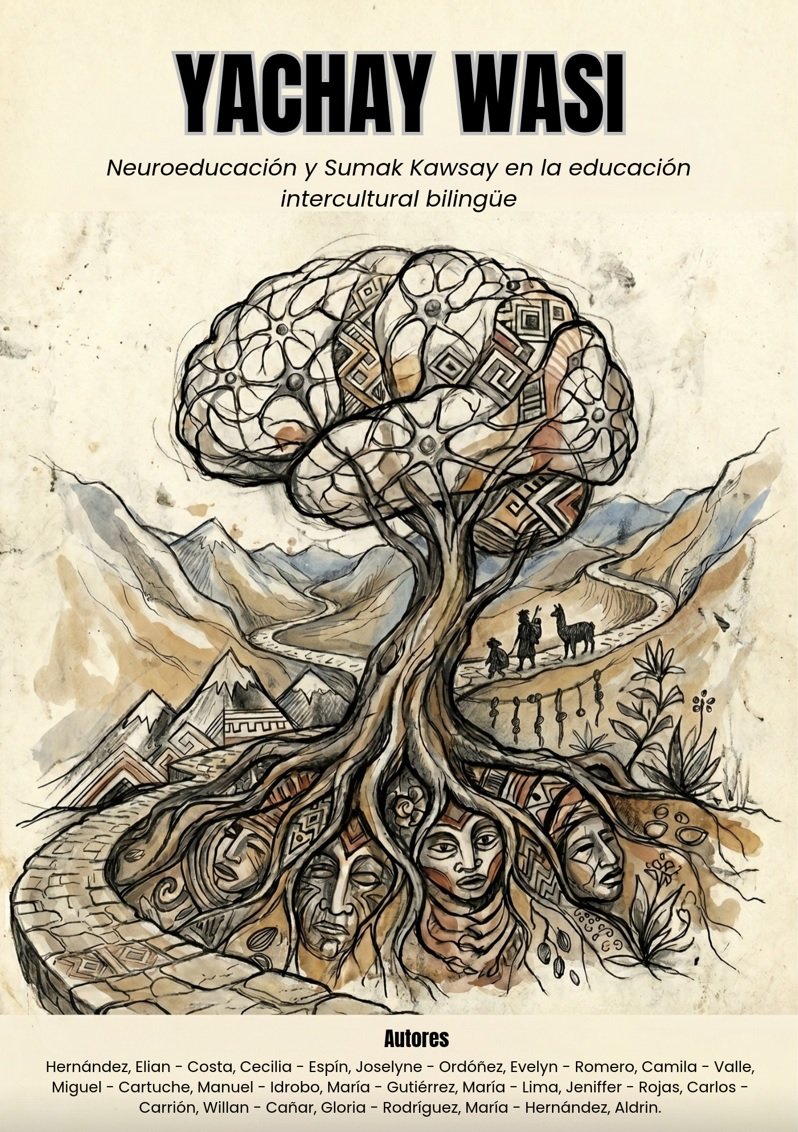
Yachay Wasi Neuroeducación y Sumak Kawsay en la educación intercultural bilingüe
Barra lateral del artículo
Contenido principal del artículo
Resumen
Este libro presenta un estudio cuasiexperimental de ocho meses sobre el programa pedagógico YACHAY WASI, que integra neuroeducación, Sumak Kawsay, etnoeducación e interculturalidad crítica. Participaron los 840 estudiantes y los 36 docentes de la Unidad Educativa Intercultural Bilingüe «Tránsito Amaguaña», que funciona en el Mercado Mayorista de Quito y atiende a familias kichwas migrantes. La mitad de los estudiantes trabajó con el programa (44 actividades en 32 semanas) y la otra mitad con la enseñanza habitual. Se midieron el rendimiento académico y cinco variables psicoeducativas mediante escalas construidas para el estudio (α entre ,84 y ,89) al inicio, a mitad y al final del periodo. Al terminar, el grupo experimental superó al grupo control en rendimiento académico (d = 0,91), motivación intrínseca (d = 1,93), identidad cultural kichwa (d = 1,67), autoeficacia académica (d = 1,57), arraigo con los saberes ancestrales (d = 2,15) y bienestar socioemocional (d = 1,90), con p < ,001 en todos los casos. Los efectos sobre identidad y arraigo fueron mayores en la adolescencia. El libro discute estos resultados con cautela, porque su magnitud supera la habitual en educación y puede estar influida por el uso de instrumentos propios y por la ausencia de aleatorización. Incluye el programa completo para su replicación.
Downloads
Detalles del artículo
Sección

Esta obra está bajo una licencia internacional Creative Commons Atribución-NoComercial 4.0.
Términos de la Licencia
Creative Commons Reconocimiento–NoComercial 4.0 Internacional (CC BY-NC 4.0)
Usted es libre de:
Compartir
Copiar y redistribuir el material en cualquier medio o formato.
Bajo los siguientes términos:
1. Reconocimiento (Atribución).
Debe dar crédito de manera adecuada, lo que implica:
- Mencionar al autor o titular de derechos.
- Incluir el título de la obra (si se proporciona).
- Incluir un enlace o referencia a la licencia CC BY-NC 4.0.
- Indicar si realizó cambios en la obra.
El reconocimiento debe hacerse de forma razonable, pero no de manera que sugiera que el autor respalda su uso.
2. NoComercial
No puede utilizar el material con fines comerciales.
Se considera uso comercial aquel cuyo propósito principal sea obtener una ventaja comercial o compensación monetaria.
Cómo citar
Share
Referencias
Bandura, A. (1977). Self-efficacy: Toward a unifying theory of behavioral change. Psychological Review, 84(2), 191-215. https://doi.org/10.1037/0033-295X.84.2.191 DOI: https://doi.org/10.1037/0033-295X.84.2.191
Bang, M., Warren, B., Rosebery, A. S. y Medin, D. (2012). Desettling expectations in science education. Human Development, 55(5-6), 302-318. https://doi.org/10.1159/000345322 DOI: https://doi.org/10.1159/000345322
Becker, M. (2008). Indians and leftists in the making of Ecuador's modern indigenous movements. Duke University Press. https://doi.org/10.1515/9780822381457 DOI: https://doi.org/10.1215/9780822381457
Berry, J. W. (2005). Acculturation: Living successfully in two cultures. International Journal of Intercultural Relations, 29(6), 697-712. https://doi.org/10.1016/j.ijintrel.2005.07.013 DOI: https://doi.org/10.1016/j.ijintrel.2005.07.013
Bialystok, E. (2011). Reshaping the mind: The benefits of bilingualism. Canadian Journal of Experimental Psychology, 65(4), 229-235. https://doi.org/10.1037/a0025406 DOI: https://doi.org/10.1037/a0025406
Bialystok, E., Craik, F. I. M. y Luk, G. (2012). Bilingualism: Consequences for mind and brain. Trends in Cognitive Sciences, 16(4), 240-250. https://doi.org/10.1016/j.tics.2012.03.001 DOI: https://doi.org/10.1016/j.tics.2012.03.001
Cabrera, N. L., Milem, J. F., Jaquette, O. y Marx, R. W. (2014). Missing the (student achievement) forest for all the (political) trees: Empiricism and the Mexican American studies controversy in Tucson. American Educational Research Journal, 51(6), 1084-1118. https://doi.org/10.3102/0002831214553705 DOI: https://doi.org/10.3102/0002831214553705
Cheung, A. C. K. y Slavin, R. E. (2016). How methodological features affect effect sizes in education. Educational Researcher, 45(5), 283-292. https://doi.org/10.3102/0013189X16656615 DOI: https://doi.org/10.3102/0013189X16656615
Cohen, J. (2013). Statistical power analysis for the behavioral sciences (2.ª ed.). Routledge. (Obra original publicada en 1988). https://doi.org/10.4324/9780203771587 DOI: https://doi.org/10.4324/9780203771587
Congreso de la República de Colombia. (1994). Ley 115 de 1994, por la cual se expide la Ley General de Educación. Diario Oficial 41.214, 8 de febrero de 1994. https://www.funcionpublica.gov.co/eva/gestornormativo/norma.php?i=292
Cubillo-Guevara, A. P. e Hidalgo-Capitán, A. L. (2015). El sumak kawsay genuino como fenómeno social amazónico ecuatoriano. OBETS: Revista de Ciencias Sociales, 10(2), 301-333. https://doi.org/10.14198/OBETS2015.10.2.02 DOI: https://doi.org/10.14198/OBETS2015.10.2.02
Dee, T. S. y Penner, E. K. (2017). The causal effects of cultural relevance: Evidence from an ethnic studies curriculum. American Educational Research Journal, 54(1), 127-166. https://doi.org/10.3102/0002831216677002 DOI: https://doi.org/10.3102/0002831216677002
Dietz, G. (2017). Interculturalidad: Una aproximación antropológica. Perfiles Educativos, 39(156), 192-207. https://doi.org/10.22201/iisue.24486167e.2017.156.58293 DOI: https://doi.org/10.22201/iisue.24486167e.2017.156.58293
Durlak, J. A., Weissberg, R. P., Dymnicki, A. B., Taylor, R. D. y Schellinger, K. B. (2011). The impact of enhancing students' social and emotional learning: A meta-analysis of school-based universal interventions. Child Development, 82(1), 405-432. https://doi.org/10.1111/j.1467-8624.2010.01564.x DOI: https://doi.org/10.1111/j.1467-8624.2010.01564.x
Emanuel, E. J., Wendler, D. y Grady, C. (2000). What makes clinical research ethical? JAMA, 283(20), 2701-2711. https://doi.org/10.1001/jama.283.20.2701 DOI: https://doi.org/10.1001/jama.283.20.2701
Faul, F., Erdfelder, E., Buchner, A. y Lang, A.-G. (2009). Statistical power analyses using GPower 3.1: Tests for correlation and regression analyses. Behavior Research Methods, 41*(4), 1149-1160. https://doi.org/10.3758/BRM.41.4.1149 DOI: https://doi.org/10.3758/BRM.41.4.1149
Fischer, K. W., Daniel, D. B., Immordino-Yang, M. H., Stern, E., Battro, A. y Koizumi, H. (2007). Why mind, brain, and education? Why now? Mind, Brain, and Education, 1(1), 1-2. https://doi.org/10.1111/j.1751-228X.2007.00006.x DOI: https://doi.org/10.1111/j.1751-228X.2007.00006.x
Freire, P. y Macedo, D. P. (1995). A dialogue: Culture, language, and race. Harvard Educational Review, 65(3), 377-403. https://doi.org/10.17763/haer.65.3.12g1923330p1xhj8 DOI: https://doi.org/10.17763/haer.65.3.12g1923330p1xhj8
Fritz, C. O., Morris, P. E. y Richler, J. J. (2012). Effect size estimates: Current use, calculations, and interpretation. Journal of Experimental Psychology: General, 141(1), 2-18. https://doi.org/10.1037/a0024338 DOI: https://doi.org/10.1037/a0024338
Gay, G. (2002). Preparing for culturally responsive teaching. Journal of Teacher Education, 53(2), 106-116. https://doi.org/10.1177/0022487102053002003 DOI: https://doi.org/10.1177/0022487102053002003
Grundy, J. G. y Timmer, K. (2017). Bilingualism and working memory capacity: A comprehensive meta-analysis. Second Language Research, 33(3), 325-340. https://doi.org/10.1177/0267658316678286 DOI: https://doi.org/10.1177/0267658316678286
Gudynas, E. (2011). Buen vivir: Today's tomorrow. Development, 54(4), 441-447. https://doi.org/10.1057/dev.2011.86 DOI: https://doi.org/10.1057/dev.2011.86
Gutiérrez, K. D. y Rogoff, B. (2003). Cultural ways of learning: Individual traits or repertoires of practice. Educational Researcher, 32(5), 19-25. https://doi.org/10.3102/0013189X032005019 DOI: https://doi.org/10.3102/0013189X032005019
Hebb, D. O. (2005). The organization of behavior: A neuropsychological theory. Psychology Press. https://doi.org/10.4324/9781410612403 DOI: https://doi.org/10.4324/9781410612403
Hornberger, N. H. (2009). Multilingual education policy and practice: Ten certainties (grounded in indigenous experience). Language Teaching, 42(2), 197-211. https://doi.org/10.1017/S0261444808005491 DOI: https://doi.org/10.1017/S0261444808005491
Howard-Jones, P. A. (2014). Neuroscience and education: Myths and messages. Nature Reviews Neuroscience, 15(12), 817-824. https://doi.org/10.1038/nrn3817 DOI: https://doi.org/10.1038/nrn3817
Hu, L. y Bentler, P. M. (1999). Cutoff criteria for fit indexes in covariance structure analysis: Conventional criteria versus new alternatives. Structural Equation Modeling, 6(1), 1-55. https://doi.org/10.1080/10705519909540118 DOI: https://doi.org/10.1080/10705519909540118
Huebner, E. S. (1991). Initial development of the Student's Life Satisfaction Scale. School Psychology International, 12(3), 231-240. https://doi.org/10.1177/0143034391123010 DOI: https://doi.org/10.1177/0143034391123010
Iacoboni, M. (2009). Imitation, empathy, and mirror neurons. Annual Review of Psychology, 60, 653-670. https://doi.org/10.1146/annurev.psych.60.110707.163604 DOI: https://doi.org/10.1146/annurev.psych.60.110707.163604
Immordino-Yang, M. H. y Damasio, A. (2007). We feel, therefore we learn: The relevance of affective and social neuroscience to education. Mind, Brain, and Education, 1(1), 3-10. https://doi.org/10.1111/j.1751-228X.2007.00004.x DOI: https://doi.org/10.1111/j.1751-228X.2007.00004.x
Instituto Nacional de Estadística y Censos. (2023). Censo Ecuador 2022: Resultados nacionales. INEC. https://www.censoecuador.gob.ec/resultados-censo/
Johnson, D. W. y Johnson, R. T. (2009). An educational psychology success story: Social interdependence theory and cooperative learning. Educational Researcher, 38(5), 365-379. https://doi.org/10.3102/0013189X09339057 DOI: https://doi.org/10.3102/0013189X09339057
Kandel, E. R. (2001). The molecular biology of memory storage: A dialogue between genes and synapses. Science, 294(5544), 1030-1038. https://doi.org/10.1126/science.1067020 DOI: https://doi.org/10.1126/science.1067020
Kern, M. L., Waters, L. E., Adler, A. y White, M. A. (2015). A multidimensional approach to measuring well-being in students: Application of the PERMA framework. The Journal of Positive Psychology, 10(3), 262-271. https://doi.org/10.1080/17439760.2014.936962 DOI: https://doi.org/10.1080/17439760.2014.936962
Kraft, M. A. (2020). Interpreting effect sizes of education interventions. Educational Researcher, 49(4), 241-253. https://doi.org/10.3102/0013189X20912798 DOI: https://doi.org/10.3102/0013189X20912798
Kroll, J. F., Dussias, P. E., Bice, K. y Perrotti, L. (2015). Bilingualism, mind, and brain. Annual Review of Linguistics, 1, 377-394. https://doi.org/10.1146/annurev-linguist-030514-124937 DOI: https://doi.org/10.1146/annurev-linguist-030514-124937
Ladson-Billings, G. (1995). Toward a theory of culturally relevant pedagogy. American Educational Research Journal, 32(3), 465-491. https://doi.org/10.3102/00028312032003465 DOI: https://doi.org/10.3102/00028312032003465
Ladson-Billings, G. (2014). Culturally relevant pedagogy 2.0: a.k.a. the remix. Harvard Educational Review, 84(1), 74-84. https://doi.org/10.17763/haer.84.1.p2rj131485484751 DOI: https://doi.org/10.17763/haer.84.1.p2rj131485484751
Lakens, D. (2013). Calculating and reporting effect sizes to facilitate cumulative science: A practical primer for t-tests and ANOVAs. Frontiers in Psychology, 4, 863. https://doi.org/10.3389/fpsyg.2013.00863 DOI: https://doi.org/10.3389/fpsyg.2013.00863
Lave, J. y Wenger, E. (1991). Situated learning: Legitimate peripheral participation. Cambridge University Press. https://doi.org/10.1017/CBO9780511815355 DOI: https://doi.org/10.1017/CBO9780511815355
Lazowski, R. A. y Hulleman, C. S. (2016). Motivation interventions in education: A meta-analytic review. Review of Educational Research, 86(2), 602-640. https://doi.org/10.3102/0034654315617832 DOI: https://doi.org/10.3102/0034654315617832
LeDoux, J. (2012). Rethinking the emotional brain. Neuron, 73(4), 653-676. https://doi.org/10.1016/j.neuron.2012.02.004 DOI: https://doi.org/10.1016/j.neuron.2012.02.004
Li, C.-H. (2016). Confirmatory factor analysis with ordinal data: Comparing robust maximum likelihood and diagonally weighted least squares. Behavior Research Methods, 48(3), 936-949. https://doi.org/10.3758/s13428-015-0619-7 DOI: https://doi.org/10.3758/s13428-015-0619-7
Lupien, S. J., McEwen, B. S., Gunnar, M. R. y Heim, C. (2009). Effects of stress throughout the lifespan on the brain, behaviour and cognition. Nature Reviews Neuroscience, 10(6), 434-445. https://doi.org/10.1038/nrn2639 DOI: https://doi.org/10.1038/nrn2639
Martínez Novo, C. (2014). Managing diversity in postneoliberal Ecuador. The Journal of Latin American and Caribbean Anthropology, 19(1), 103-125. https://doi.org/10.1111/jlca.12062 DOI: https://doi.org/10.1111/jlca.12062
McCarty, T. L. y Lee, T. S. (2014). Critical culturally sustaining/revitalizing pedagogy and indigenous education sovereignty. Harvard Educational Review, 84(1), 101-124. https://doi.org/10.17763/haer.84.1.q83746nl5pj34216 DOI: https://doi.org/10.17763/haer.84.1.q83746nl5pj34216
McEwen, B. S. (2007). Physiology and neurobiology of stress and adaptation: Central role of the brain. Physiological Reviews, 87(3), 873-904. https://doi.org/10.1152/physrev.00041.2006 DOI: https://doi.org/10.1152/physrev.00041.2006
McGaugh, J. L. (2004). The amygdala modulates the consolidation of memories of emotionally arousing experiences. Annual Review of Neuroscience, 27, 1-28. https://doi.org/10.1146/annurev.neuro.27.070203.144157 DOI: https://doi.org/10.1146/annurev.neuro.27.070203.144157
Messick, S. (1995). Validity of psychological assessment: Validation of inferences from persons' responses and performances as scientific inquiry into score meaning. American Psychologist, 50(9), 741-749. https://doi.org/10.1037/0003-066X.50.9.741 DOI: https://doi.org/10.1037/0003-066X.50.9.741
Mignolo, W. D. (2007). Delinking: The rhetoric of modernity, the logic of coloniality and the grammar of de-coloniality. Cultural Studies, 21(2-3), 449-514. https://doi.org/10.1080/09502380601162647 DOI: https://doi.org/10.1080/09502380601162647
Moll, L. C., Amanti, C., Neff, D. y González, N. (1992). Funds of knowledge for teaching: Using a qualitative approach to connect homes and classrooms. Theory Into Practice, 31(2), 132-141. https://doi.org/10.1080/00405849209543534 DOI: https://doi.org/10.1080/00405849209543534
Naciones Unidas. (2007). Declaración de las Naciones Unidas sobre los Derechos de los Pueblos Indígenas. https://www.un.org/esa/socdev/unpfii/documents/DRIPS_es.pdf
OCDE. (2019). PISA 2018 results (Volume III): What school life means for students' lives. OECD Publishing. https://doi.org/10.1787/acd78851-en DOI: https://doi.org/10.1787/acd78851-en
Organización Internacional del Trabajo. (1989). Convenio sobre pueblos indígenas y tribales, 1989 (núm. 169). https://normlex.ilo.org/dyn/nrmlx_es/f?p=NORMLEXPUB:12100:0::NO::P12100_ILO_CODE:C169
Pajares, F. (1996). Self-efficacy beliefs in academic settings. Review of Educational Research, 66(4), 543-578. https://doi.org/10.3102/00346543066004543 DOI: https://doi.org/10.3102/00346543066004543
Paris, D. (2012). Culturally sustaining pedagogy: A needed change in stance, terminology, and practice. Educational Researcher, 41(3), 93-97. https://doi.org/10.3102/0013189X12441244 DOI: https://doi.org/10.3102/0013189X12441244
Phinney, J. S. (1992). The multigroup ethnic identity measure: A new scale for use with diverse groups. Journal of Adolescent Research, 7(2), 156-176. https://doi.org/10.1177/074355489272003 DOI: https://doi.org/10.1177/074355489272003
Porter, J. M. y Morrison, A. R. (2024). From pilots to policies: Challenges for implementing intercultural bilingual education in Latin America. International Review of Education, 70(1), 11-28. https://doi.org/10.1007/s11159-023-10039-5 DOI: https://doi.org/10.1007/s11159-023-10039-5
Quijano, A. (2007). Coloniality and modernity/rationality. Cultural Studies, 21(2-3), 168-178. https://doi.org/10.1080/09502380601164353 DOI: https://doi.org/10.1080/09502380601164353
Rizzolatti, G., Fadiga, L., Gallese, V. y Fogassi, L. (1996). Premotor cortex and the recognition of motor actions. Cognitive Brain Research, 3(2), 131-141. https://doi.org/10.1016/0926-6410(95)00038-0 DOI: https://doi.org/10.1016/0926-6410(95)00038-0
Rodríguez Cruz, M. (2018). Construir la interculturalidad: Políticas educativas, diversidad cultural y desigualdad en el Ecuador. Íconos: Revista de Ciencias Sociales, (60), 217-236. https://doi.org/10.17141/iconos.60.2018.2922 DOI: https://doi.org/10.17141/iconos.60.2018.2922
Rosseel, Y. (2012). lavaan: An R package for structural equation modeling. Journal of Statistical Software, 48(2), 1-36. https://doi.org/10.18637/jss.v048.i02 DOI: https://doi.org/10.18637/jss.v048.i02
Rubin, D. B. (1987). Multiple imputation for nonresponse in surveys. Wiley. https://doi.org/10.1002/9780470316696 DOI: https://doi.org/10.1002/9780470316696
Ryan, R. M. y Deci, E. L. (2000). Intrinsic and extrinsic motivations: Classic definitions and new directions. Contemporary Educational Psychology, 25(1), 54-67. https://doi.org/10.1006/ceps.1999.1020 DOI: https://doi.org/10.1006/ceps.1999.1020
Santos, B. de S. (2015). Epistemologies of the South: Justice against epistemicide. Routledge. https://doi.org/10.4324/9781315634876 DOI: https://doi.org/10.4324/9781315634876
Shadish, W. R. (2010). Campbell and Rubin: A primer and comparison of their approaches to causal inference in field settings. Psychological Methods, 15(1), 3-17. https://doi.org/10.1037/a0015916 DOI: https://doi.org/10.1037/a0015916
Squire, L. R. (2004). Memory systems of the brain: A brief history and current perspective. Neurobiology of Learning and Memory, 82(3), 171-177. https://doi.org/10.1016/j.nlm.2004.06.005 DOI: https://doi.org/10.1016/j.nlm.2004.06.005
Steele, C. M. (1997). A threat in the air: How stereotypes shape intellectual identity and performance. American Psychologist, 52(6), 613-629. https://doi.org/10.1037/0003-066X.52.6.613 DOI: https://doi.org/10.1037/0003-066X.52.6.613
Suldo, S. M., Riley, K. N. y Shaffer, E. J. (2006). Academic correlates of children and adolescents' life satisfaction. School Psychology International, 27(5), 567-582. https://doi.org/10.1177/0143034306073411 DOI: https://doi.org/10.1177/0143034306073411
Sullivan, G. M. y Feinn, R. (2012). Using effect size, or why the P value is not enough. Journal of Graduate Medical Education, 4(3), 279-282. https://doi.org/10.4300/JGME-D-12-00156.1 DOI: https://doi.org/10.4300/JGME-D-12-00156.1
Swanson, K. (2007). Revanchist urbanism heads south: The regulation of indigenous beggars and street vendors in Ecuador. Antipode, 39(4), 708-728. https://doi.org/10.1111/j.1467-8330.2007.00548.x DOI: https://doi.org/10.1111/j.1467-8330.2007.00548.x
Taber, K. S. (2018). The use of Cronbach's alpha when developing and reporting research instruments in science education. Research in Science Education, 48(6), 1273-1296. https://doi.org/10.1007/s11165-016-9602-2 DOI: https://doi.org/10.1007/s11165-016-9602-2
Tulving, E. (2002). Episodic memory: From mind to brain. Annual Review of Psychology, 53, 1-25. https://doi.org/10.1146/annurev.psych.53.100901.135114 DOI: https://doi.org/10.1146/annurev.psych.53.100901.135114
Tyng, C. M., Amin, H. U., Saad, M. N. M. y Malik, A. S. (2017). The influences of emotion on learning and memory. Frontiers in Psychology, 8, 1454. https://doi.org/10.3389/fpsyg.2017.01454 DOI: https://doi.org/10.3389/fpsyg.2017.01454
Umaña-Taylor, A. J., Douglass, S., Updegraff, K. A. y Marsiglia, F. F. (2018). A small-scale randomized efficacy trial of the Identity Project: Promoting adolescents' ethnic-racial identity exploration and resolution. Child Development, 89(3), 862-870. https://doi.org/10.1111/cdev.12755 DOI: https://doi.org/10.1111/cdev.12755
van Buuren, S. y Groothuis-Oudshoorn, K. (2011). mice: Multivariate imputation by chained equations in R. Journal of Statistical Software, 45(3), 1-67. https://doi.org/10.18637/jss.v045.i03 DOI: https://doi.org/10.18637/jss.v045.i03
Varela, F. J., Thompson, E. y Rosch, E. (1991). The embodied mind: Cognitive science and human experience. MIT Press. https://doi.org/10.7551/mitpress/6730.001.0001 DOI: https://doi.org/10.7551/mitpress/6730.001.0001
Villalba, U. (2013). Buen vivir vs development: A paradigm shift in the Andes? Third World Quarterly, 34(8), 1427-1442. https://doi.org/10.1080/01436597.2013.831594 DOI: https://doi.org/10.1080/01436597.2013.831594
Vygotsky, L. S. (1980). Mind in society: Development of higher psychological processes (M. Cole, V. John-Steiner, S. Scribner y E. Souberman, Eds.). Harvard University Press. https://doi.org/10.2307/j.ctvjf9vz4 DOI: https://doi.org/10.2307/j.ctvjf9vz4
Walsh, C. (2010). Development as buen vivir: Institutional arrangements and (de)colonial entanglements. Development, 53(1), 15-21. https://doi.org/10.1057/dev.2009.93 DOI: https://doi.org/10.1057/dev.2009.93
Weijters, B., Baumgartner, H. y Schillewaert, N. (2013). Reversed item bias: An integrative model. Psychological Methods, 18(3), 320-334. https://doi.org/10.1037/a0032121 DOI: https://doi.org/10.1037/a0032121
Wigfield, A. y Eccles, J. S. (2020). 35 years of research on students' subjective task values and motivation: A look back and a look forward. En A. J. Elliot (Ed.), Advances in motivation science (Vol. 7, pp. 161-198). Elsevier. https://doi.org/10.1016/bs.adms.2019.05.002 DOI: https://doi.org/10.1016/bs.adms.2019.05.002